A Whale-Sized Question
Protestors ask: Will Iceland be the last country on Earth to ban whaling?
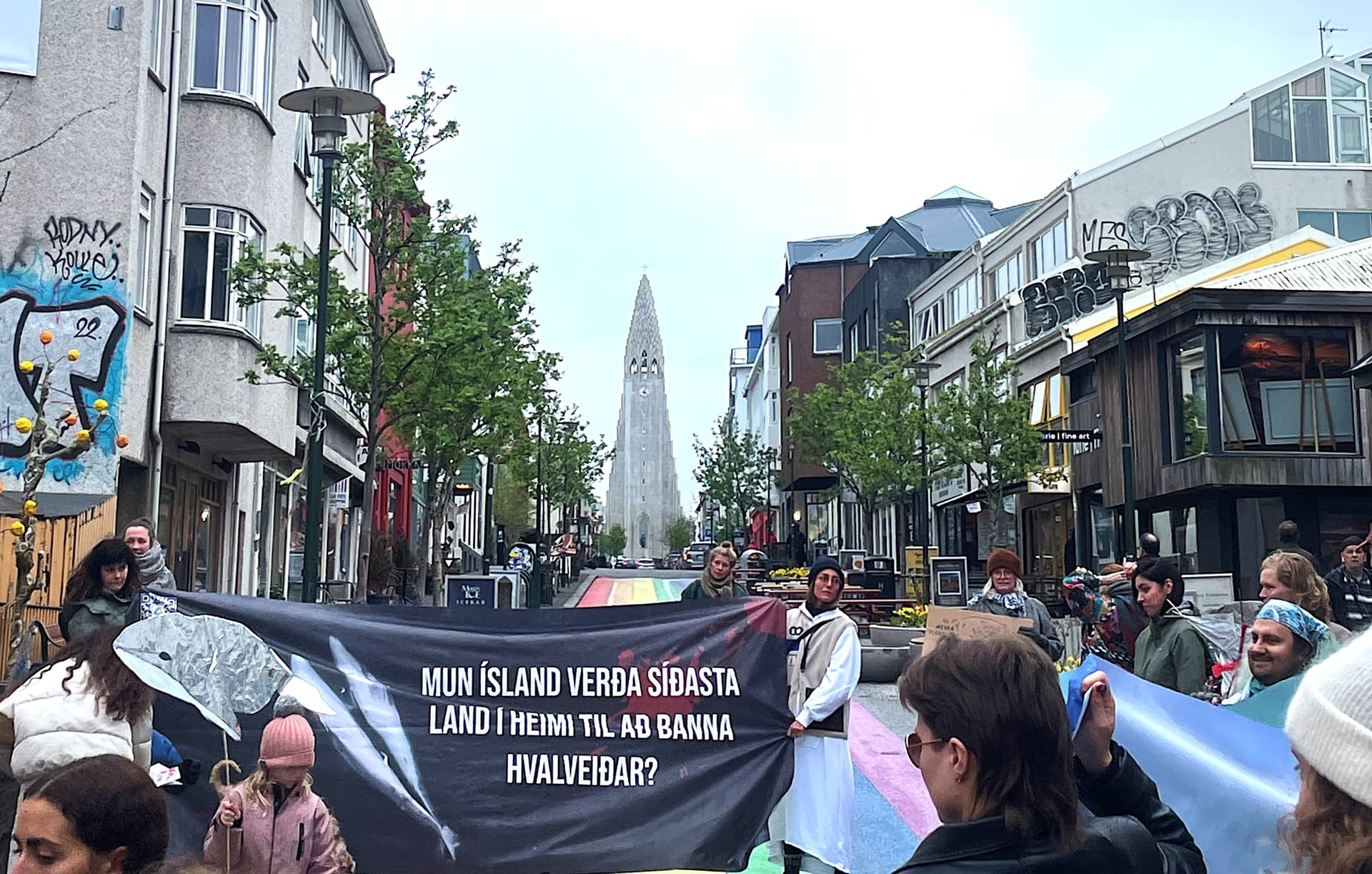
REYKJAVÍK, 16 May 2023 – A layover in Iceland that was supposed to last three hours just didn't sit right with me. I decided to push back my flight a couple of days to experience the land of fire and ice. The images I had seen and stories I had heard of the natural beauty were too intriguing to pass up for another terminal and departure gate.
Reykjavík, blustery and wet, was the typical gray you'd expect on a North Atlantic May morning. This dreariness sharply contrasted with the pastel-colored Scandinavian architecture that lined the narrow streets. As I made my way down Skólavörðustígur road, I came upon a group of young protestors in the shadow of the soaring Hallgrímskirkja church. They held up a banner that read in Icelandic: “Will Iceland be the last country on Earth to ban whaling?”
Iceland's is one of only three nations—along with Japan and Norway—that refuses to recognize the International Whaling Commission’s (IWC) 1986 moratorium on whaling. The country's relationship with the practice has been one of stubborn exception: it stopped whaling by 1989, quietly withdrew from the IWC in 1992, rejoined a decade later on its own terms, and by 2006 had resumed commerical hunting entirely. Today, fin whales and minke whales are the sole targets of Icelandic vessels. Hvalur hf, led by Kristján Loftsson, is the only commercial hunter of fin whales in Europe.
The fin whale population is classified as highly endangered by the World Wildlife Fund (WWF) and vulnerable by the International Union for Conservation of Nature (IUCN), two different scales but the same alarming trajectory.
Despite this, nearly 90% of what Hvalur hr catches is shipped directly to Japan. An endangered whale, hunted by one man, for a market thousands of miles away.
Months after this protest, on 20 June, the Icelandic government halted the annual start of the whaling season over the brutality of the hunt itself.
Videos circulated showing harpooned whales taking up to Icelandic law requires the hunt of any animal to be done quickly and painlessly, and questions had been raised about the brutality of the whaling process. This halt followed public reaction to numerous incidents of harpooning taking between 30 minutes to two hours to die after the initial strike. The public reaction was swift, and for a brief moment it seemed as though the season might not resume at all.
It did.
On 1 September, under the close supervision of the Icelandic Food and Veterinary Authority which mandated immediate kills, daylight-only hunting, approved weapons, and videotaped evidence of every hunt. The self-imposed quota of 209 fin whales that was set in 2019, remained in place.
The case against whaling in Iceland is environmental, but also cultural, economic, and increasingly demographic. A 2023 poll found that 42% of Icelandic citizens oppose whaling, whereas only 29% support it. Only around 3% of Icelandic citizens eat whale meat and that number continues to shrink, so cultural arguments are hollow.
The economics are harder to defend. Whaling makes up less than 1% of total seafood export, and the industry posted a loss of $7.5 million in 2015.
Meanwhile, whale watching generates around $12 million annually, with 1 in 5 tourists taking part. In 2017, tourism accounted for nearly half of Iceland’s economy. Whales are worth considerably more alive than dead.
Whaling is defended as an economic benefit to a small nation, but the numbers say otherwise. The dwindling fin whale population should be enough to outright ban whaling, but with the other compounding factors, how it persists is the real question.
I stayed for about an hour, watching Iceland’s young generation push for change. A replica whale skeleton had been arranged on the street while a young woman pleaded over a megaphone. Her Icelandic speech was incomprehensible to me, but the passion and the strain in her voice were not.
I continued my walk to the Hallgrímskirkja, with mixed feelings about what I had encountered. I felt hope that the youth here were like the youth anywhere else in the world: determined and passionate. At the same time, I worried the whaling industry might be too powerful an opponent to resist. Nevertheless, there is work to be done—and somewhere on Skólavörðustígur road, her voice is still ringing in my ears to remind me of that.